
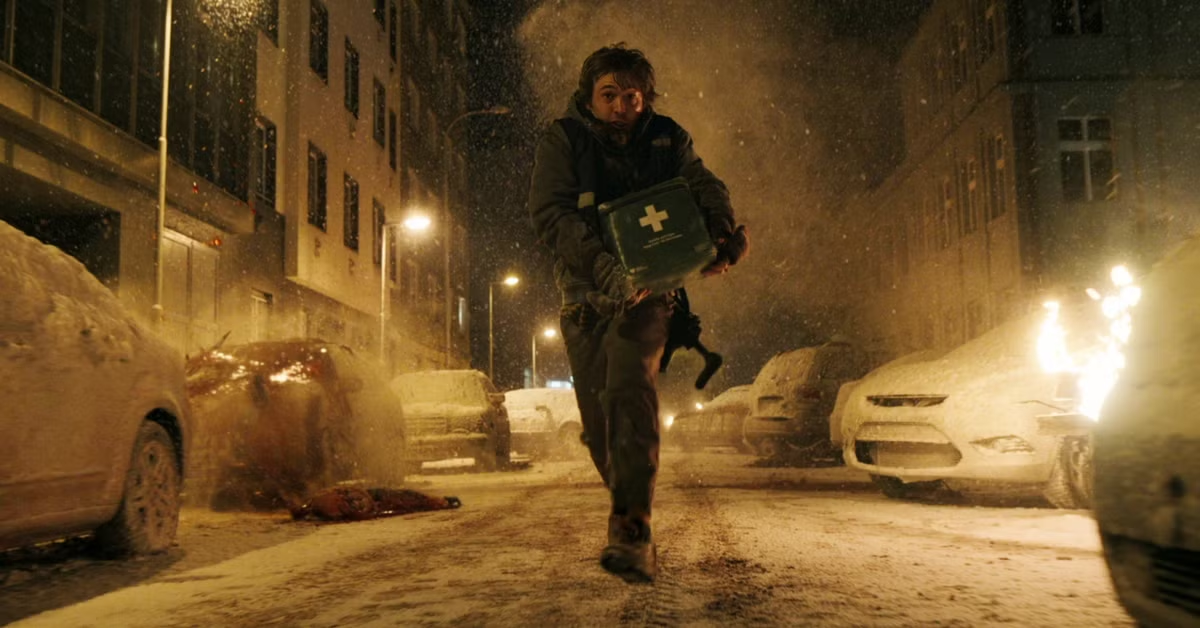
I’m a big believer that games like Resident Evil, while not all technically co-op, are a team sport. It’s a fun, exhilarating, sometimes exhausting way to spend an evening; resource management is scarce and frustrating, panic is high, and the game overall leans into a campiness that can create a lot of laughs if you play with a friend or group of friends. “RUN!” “No, go back that way!” “You’re out of bullets!”
The latest film adaptation, from Zach Cregger, manages to deliver that same group-sport commentary in theatrical form. I’m not sure I’ve ever heard an audience groan, argue, or even downright beg a film’s protagonist to make a different choice, run a different way, or just plain old do a better job. Much like the game, it works best as a shared experience.
The plot of Resident Evil is fairly straightforward: Bryan (Austin Abrams) is a medical courier trying to make a few extra bucks before heading home for the day. He receives a mysterious and high-priority delivery that takes him to the snowy Raccoon City. While arguing with his girlfriend on the phone, he gets distracted and surprised when a woman jumps out in front of his car. This turns out to be the first of many experiences Bryan will have with the zombified residents of Raccoon City, and as he rushes from one near-death encounter to the next, he centers in on the city’s hospital, where he can seek refuge and a shot at helping deliver a cure to the rapidly-expanding illness.
Up to this point, a Venn diagram showing the overlap between the success of Zack Cregger and the success of Resident Evil live-action adaptations wouldn’t be a Venn diagram at all so much as two separate circles. Cregger is having a huge moment after the one-two punch of 2022’s breakout hit Barbarian and 2025’s massive success, Weapons, which earned Amy Madigan an Academy Award for her performance as the iconic Aunt Gladys. Resident Evil, meanwhile, has seen more than a decade of one failed revival and sequel attempt after the other, fading into relative obscurity in theatrical form.
So it’s fair to say the bar is sitting in one position for Cregger and in an altogether different place for Resident Evil films in general, and my feelings on Cregger‘s adaptation pretty much reflect that difference. I haven’t seen them all, but I have no problem assuming that this is easily the best Resident Evil adaptation ever made (to be more objective, we can look at aggregate review scores, which back that up). It’s a tight 90-minute thrill ride, and it’s one of the funniest horror movies I’ve seen in a long time, though Cregger has said he cut some of the comedy. As a comedy it’s firing on every cylinder, mostly due to the successful one-man-show performance delivered by Abrams, who played my favorite role in last year’s Weapons. Resident Evil also excels at constantly setting up expectations and then cleanly dashing them — you sort of know where the film is going but also absolutely really don’t, with the movie pulling the rug out from under you regularly, using all sorts of Chekhov’s-gun-style plot devices as an act of defiance rather than a way to close predictable loops. It’s a film that’s easy to recommend and fun to watch.
I have to mention the other side of the coin, though — the Cregger bar. Of his three directorial efforts, this one still squarely falls in the “good” column, but is my least favorite of his films to date. It’s funny, honors the franchise well, and in the first hour especially manages to create a nice mixture of dread, action, and comedy. The film’s propulsive end, though, relies heavily on CGI and ever-increasing spectacle on a budget that doesn’t look like it can support the effort, and although I agreed with the spirit of the ending on paper, the actual execution fell a little flat, especially compared to everything that came before. I also think it’s his least scary or horrific of the crop, struggling to create much genuine tension or dread as the stakes and size of the threat escalates.
Still, I’d chalk this one up to a win on the whole — it’s a great get for the franchise, and Cregger pulls off something very few filmmakers would even attempt in resuscitating such a mired film franchise.